
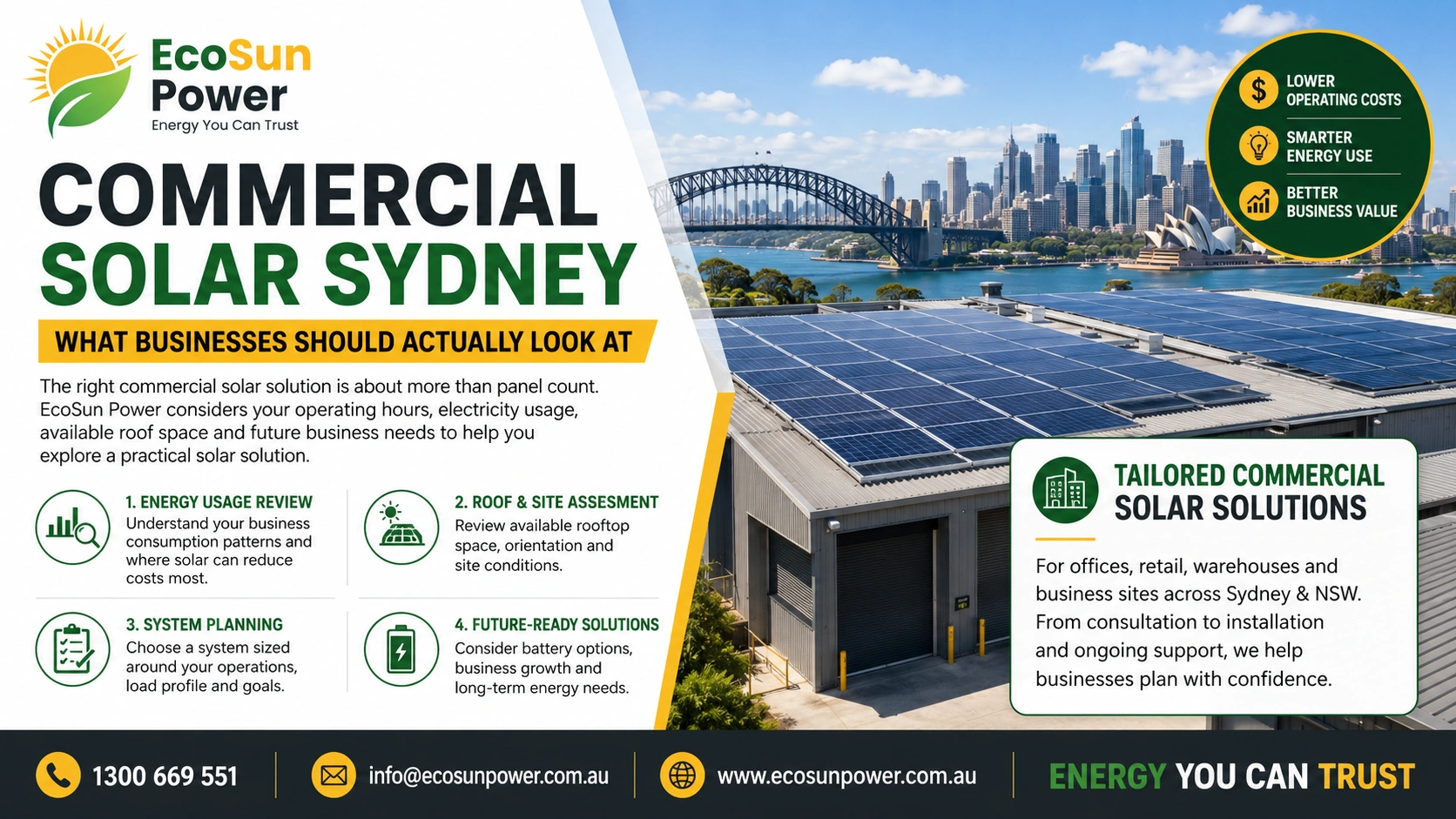
If your electricity bill keeps climbing every year, commercial solar in Sydney starts looking less like an environmental upgrade and more like a practical way to control operating costs.
That is usually where the conversation begins.
Not with panels.
Not with sustainability reports.
With the electricity bill.
For warehouses, offices, workshops, retail stores, childcare centres, medical facilities and other Sydney businesses, electricity is one of those operating expenses that arrives every month whether you like it or not.
Commercial solar can help reduce that dependence on grid electricity.
But the system has to make sense for the way your business actually operates.
A bigger system is not automatically a better system.
Commercial Solar Works Differently for Businesses
Commercial solar is not simply residential solar installed on a bigger roof.
Businesses often have completely different electricity-use patterns from homes, which can significantly change how a solar system should be designed.
Businesses Often Use Power When Solar Is Producing
Many homes have relatively low electricity consumption during the middle of the day.
People are at work.
Children are at school.
A lot of household electricity use happens later in the afternoon or evening.
Many businesses work the other way around.
Daytime Business Loads Can Match Solar Generation
During normal business hours, a commercial site may have:
- Air conditioning running
- Computers and servers operating
- Machinery working
- Refrigeration running
- Lighting switched on
- Pumps and lifts operating
- Production equipment in use
All of that is happening while the solar system is producing electricity.
Direct Solar Use Can Be Particularly Valuable
When your business consumes solar electricity as it is generated, that energy can replace electricity you would otherwise purchase from the grid.
That is why daytime electricity consumption is such an important part of commercial solar economics.
Your Electricity Usage Should Come Before Your Roof Size
A large commercial roof often creates an obvious question:
“How many panels can we fit up there?”
It is worth knowing.
But it should not be the first question.
Start With How Much Electricity the Business Actually Uses
The better starting point is understanding:
- How much electricity your business consumes
- When that electricity is consumed
- How demand changes throughout the day
- Whether consumption changes by season
- How much electricity is used outside daylight hours
Look at Interval Data Where Available
Electricity bills give you useful information, but interval or half-hourly usage data can tell you much more.
It can show exactly when your business draws power from the grid.
That makes it easier to understand how much solar generation could realistically be consumed on-site.
System Size Should Follow the Load Profile
A 100 kW solar system may sound impressive.
But if your business only requires a small portion of that electricity during the day, a large amount of generation may end up being exported.
That can significantly change the financial outcome.
Sydney Businesses Should Consider Seasonal Electricity Demand
Electricity consumption does not necessarily remain the same throughout the year.
For many Sydney businesses, summer and winter can look very different.
Air Conditioning Can Change the Load Profile
Commercial buildings with substantial air-conditioning requirements may experience much higher daytime electricity consumption during warmer months.
That can create a strong match with solar generation.
Other Seasonal Loads Matter Too
Seasonal differences can also come from:
- Refrigeration
- Heating
- Production schedules
- Extended trading hours
- Seasonal customer demand
- Changes in staffing or occupancy
Annual Electricity Totals Do Not Tell the Whole Story
Two businesses may consume a similar amount of electricity over a year but use that electricity at very different times.
Those timing differences can lead to different commercial solar designs.
How Much Commercial Solar Does Your Sydney Business Need?
There is no standard commercial solar system size that works for every business.
A café, medical centre, office, warehouse and manufacturing facility can occupy buildings of similar size but require completely different systems.
Electricity Consumption Should Guide System Size
Important factors include:
- Daytime electricity consumption
- Operating hours
- Peak demand
- Usable roof area
- Roof orientation
- Shading
- Export capacity
- Electrical infrastructure
- Future energy requirements
Available Roof Space Is Only One Factor
A large roof tells you how much solar you might physically be able to install.
It does not tell you how much solar your business should install.
The Best System Is Usually the One That Matches the Site
System sizing should balance physical capacity with electricity consumption and financial objectives.
The goal is not necessarily to cover every available section of roof with panels.
Future Business Growth Can Change the Solar Calculation
A commercial solar system is usually expected to operate for many years.
So it makes sense to consider how the business may change.
Think About Future Electricity Loads
Your future plans might include:
- Additional production equipment
- Another production line
- More refrigeration
- Business expansion
- Longer operating hours
- EV chargers
- Electric machinery
- Expansion into neighbouring premises
Some Future Growth Can Justify Additional Capacity
If there is a clear plan to increase electricity consumption, installing some additional solar capacity today may make sense.
Avoid Oversizing Based Only on Possibilities
There is a difference between planned growth and hypothetical growth.
A larger system should have a realistic reason behind it rather than being installed simply because there is available roof space.
Commercial Solar Payback Needs Realistic Assumptions
Commercial solar is a business investment.
Naturally, one of the first financial questions is:
“How long will it take to pay for itself?”
Several Factors Affect Solar Payback
These can include:
- Installation cost
- System size
- Electricity tariffs
- Solar generation
- Daytime electricity consumption
- Solar self-consumption
- Export rates
- Operating hours
Strong Daytime Consumption Can Help
Businesses that consume significant electricity during daylight hours may be able to use more of their solar generation directly.
That can reduce the amount of electricity purchased from the grid.
Direct Consumption Often Matters More Than the Headline System Size
A well-matched system may provide a stronger business case than a much larger system that exports substantial excess generation.
Do Not Base Payback on Perfect Conditions
Financial projections are useful.
They are still projections.
Real Business Conditions Change
Over the life of a solar system:
- Electricity tariffs may change
- Business usage may increase or decrease
- Operating hours may change
- Solar generation will vary
- Equipment performance will gradually change
- Occasional downtime may occur
Conservative Financial Modelling Can Be More Useful
A realistic estimate gives you a better basis for making a business decision than an unusually optimistic one.
Look Behind the Payback Number
If one proposal shows dramatically better savings than another similar proposal, check the assumptions.
The biggest savings figure is not automatically the most accurate one.
Cheap Commercial Solar Can Become Expensive Later
Businesses commonly compare commercial solar proposals based on two things:
System size and price.
That makes sense as a starting point.
It should not be the end of the comparison.
Two 50 kW Solar Systems Can Be Very Different
The system capacity may be identical while the actual project differs significantly.
Differences can include:
- Solar panel quality
- Inverter selection
- Mounting equipment
- Monitoring
- Electrical design
- Installation workmanship
- Warranty coverage
- After-sales support
Installation Scope Can Also Be Different
One quote may include work that another excludes.
That could involve:
- Switchboard modifications
- Cable runs
- Network applications
- Scaffolding
- Roof access
- Monitoring equipment
- Additional electrical work
Compare the Complete Project, Not Just the Price
A cheaper quote is only genuinely cheaper when it includes the work your site actually requires.
Otherwise, the missing costs may simply appear later.
Commercial Installation Quality Matters
Commercial sites can be considerably more complicated than residential properties.
That makes good planning and workmanship particularly important.
Commercial Buildings Can Have Complex Infrastructure
An installer may need to work around:
- Three-phase electrical systems
- Main switchboards
- Distribution boards
- Machinery
- Existing solar systems
- Air-conditioning equipment
- Skylights
- Roof vents
- Multiple tenancies
- Restricted access areas
Small Installation Details Can Matter for Years
Details such as cable routing, inverter placement, mounting quality and equipment access may not look exciting in a proposal.
But they become important when the system needs inspection, maintenance or repair.
Design for Future Maintenance as Well as Installation
A good installation should not only work on commissioning day.
It should remain practical to inspect and maintain over the life of the system.
Check the Roof Before Installing Commercial Solar
The roof should be assessed before a large solar system is installed.
This is particularly important on older commercial properties.
Existing Roof Condition Matters
A commercial roof may have:
- Corrosion
- Previous repairs
- Patched areas
- Skylights
- Roof vents
- Air-conditioning equipment
- Drainage areas
- Structural limitations
- Difficult access
Complete Necessary Roof Repairs First
If substantial repairs or roof replacement are already approaching, dealing with them before solar installation can save considerable inconvenience later.
Avoid Removing and Reinstalling Solar Unnecessarily
Removing hundreds of panels to complete roof repairs means additional labour, access equipment and business disruption.
Planning roof and solar work together can avoid paying for the same type of work twice.
Should Your Sydney Business Add a Solar Battery?
Commercial batteries can be useful.
But battery storage should solve a real business problem.
It should not be added simply because batteries are popular or because the proposal looks more complete with one.
Solar and Batteries Perform Different Jobs
Solar generates electricity while sunlight is available.
A battery stores energy so that it can potentially be used later.
Your Operating Hours Affect Battery Value
A business that closes at 5 pm and consumes very little electricity overnight may have a different battery case from a:
- Hotel
- Restaurant
- Supermarket
- Gym
- Cold storage facility
- Factory running evening shifts
Start With the Load Profile Before Adding Storage
The important question is not simply:
“Can we install a battery?”
It is:
“What problem will the battery solve?”
That answer should come from the site’s electricity data.
Commercial Batteries Can Have More Than One Purpose
Battery storage is not only about saving daytime solar for the evening.
Different businesses may have different requirements.
Possible Commercial Battery Uses
A battery may potentially support:
- Evening electricity consumption
- Excess solar storage
- Peak-demand management
- Tariff shifting
- Selected backup loads
- EV charging
Demand Management Can Be Important for Some Sites
For businesses affected by demand charges, reducing short periods of high grid demand may have value.
A suitably designed battery may help manage those peaks.
Battery Design Still Needs Real Electricity Data
Capacity, discharge power, timing and control strategy all matter.
The battery brochure alone cannot tell you whether the system will work financially for your business.
Commercial Solar Maintenance Should Not Be Ignored
Solar systems are generally considered low-maintenance.
Low-maintenance does not mean zero-maintenance.
Commercial Systems Need Ongoing Visibility
Large installations may contain hundreds of panels, multiple inverters and substantial electrical infrastructure.
Potential issues can include:
- Dirt and dust
- Bird droppings
- Leaves and debris
- Inverter faults
- Communication problems
- Monitoring failures
- Damaged equipment
Underperformance May Not Be Obvious
If part of the solar system stops producing, the business may continue operating normally.
Grid electricity simply makes up the difference.
Monitoring Can Help Identify Problems Earlier
Remote monitoring makes it easier to notice unusual drops in generation or equipment faults.
Regular inspection requirements should then be based on the site itself.
Maintenance Requirements Depend on the Site
Not every commercial solar installation needs exactly the same maintenance schedule.
Site Conditions Make a Difference
A dusty industrial facility may have different requirements from:
- A suburban office building
- A coastal commercial property
- A warehouse near heavy traffic
- A retail centre
- A food-processing facility
Cleaning Should Be Based on Actual Conditions
There is little value in following an unnecessarily aggressive cleaning schedule if the system does not need it.
At the same time, ignoring obvious buildup is not useful either.
Monitor Performance and Respond Accordingly
Maintenance should be based on equipment requirements, site conditions and actual system performance.
Should You Install the Maximum Solar Your Roof Can Take?
Not necessarily.
A roof’s physical capacity and the ideal solar system size are two different things.
Design Around Electricity Consumption First
If your main goal is reducing daytime grid electricity purchases, the system should be designed with your daytime load in mind.
Excess Generation May Be Exported
Once solar production exceeds what the business can consume, the remaining electricity may be exported, subject to the site’s connection arrangements.
More Generation Is Not Automatically More Valuable
The value of additional panels depends on what happens to the electricity they produce.
That should be considered before automatically maximising the roof.
Grid Connection and Export Requirements Matter
Commercial solar projects also need to work within applicable network and connection requirements.
Export Capacity Can Affect System Design
Depending on the site and proposed system, connection requirements can influence:
- System capacity
- Export limits
- Inverter configuration
- Network applications
- Additional equipment
Larger Projects May Need More Planning
As commercial system size increases, network considerations can become more significant.
Confirm Requirements Before Finalising the Design
It is better to understand practical connection limits before becoming committed to a particular system size.
Leasing a Commercial Building Changes the Conversation
Many Sydney businesses operate from leased properties.
Commercial solar can still be possible.
It simply requires more coordination.
The Property Owner May Need to Approve the Installation
Potential considerations include:
- Roof access
- Installation permission
- Electrical modifications
- Equipment location
- Responsibility for the system
- Future removal or transfer arrangements
Lease Duration Matters
If the business expects to relocate in a couple of years, investing heavily in permanent rooftop infrastructure deserves careful assessment.
Owner-Occupiers Usually Have a Simpler Decision
Businesses that own and occupy the property generally have greater control over both the installation and long-term benefit.
Tenants need to consider the solar business case alongside their lease arrangements.
What Should Be Included in a Commercial Solar Quote?
A good commercial solar quote should tell you exactly what you are buying.
A description such as:
“100 kW premium solar system”
is not enough on its own.
Check the Equipment Details
The proposal should clearly identify:
- Solar panel brand and model
- Inverter brand and model
- Proposed system capacity
- Monitoring platform
- System layout where appropriate
- Estimated annual generation
Check the Financial Assumptions
The quote should also explain:
- Expected savings
- Solar self-consumption assumptions
- Export assumptions
- Electricity price assumptions
- Estimated payback
Understand How the Numbers Were Produced
A savings figure is much more useful when you understand what assumptions sit behind it.
Check What the Installation Price Actually Includes
The equipment list is only part of a commercial solar quote.
The installation scope matters just as much.
Important Inclusions to Check
Ask whether the proposal includes:
- Switchboard modifications
- Network applications
- Scaffolding
- Elevated access equipment
- Monitoring setup
- Electrical upgrades
- Commissioning
- Site-specific works
Ask About After-Sales Support
It is also worth knowing what happens after installation.
Who handles faults?
Who assists with warranty claims?
Who checks unexplained production problems?
Pay Attention to the Exclusions
Sometimes a quote looks cheaper because difficult parts of the project have not been included.
Those exclusions should be identified before you compare the final price.
Commercial Solar Should Be Easy for the Business to Understand
Your team should not need to become solar experts just to make a sensible investment decision.
Focus on the Numbers That Matter
You should be able to understand:
- How much electricity you currently use
- When you use it
- How much solar is being proposed
- How much electricity the system is expected to generate
- How much solar you are likely to consume
- How much may be exported
- What the realistic financial outcome may be
Technical Detail Should Support the Decision
Panel specifications and inverter features matter.
But they should support the business case rather than distract from it.
The System Should Make Sense on a Normal Working Day
Think about what actually happens inside your business.
Machines running at 10 am.
Air conditioning working hard at 2 pm.
Cold rooms operating continuously.
Office staff working Monday to Friday.
Warehouses quieter over the weekend.
Those details can tell you a lot about whether the proposed commercial solar system is properly matched to the site.
What Should Businesses Actually Look At Before Installing Commercial Solar in Sydney?
For businesses considering commercial solar in Sydney, available roof space is only the starting point.
The more important question is whether the system fits the way the business consumes electricity.
Review the Complete Energy Picture
Before proceeding, look at:
- Electricity consumption
- Daytime usage
- Operating hours
- Seasonal demand
- Peak demand
- Roof condition
- Available roof area
- Electrical infrastructure
- Grid connection requirements
- Export limitations
- Future growth
- Battery requirements
- Installation quality
- Monitoring
- Maintenance
- Warranty
- After-sales support
- Financial assumptions
Choose a System That Fits the Business
The best commercial solar system is not necessarily the one with the most panels.
It is the one designed around the actual requirements of the site.
Start With the Electricity Data, Then Design the Solar System
Start with the electricity bill.
Look at the usage data.
Understand when your business consumes electricity.
Identify what is happening during solar production hours.
Then decide how much commercial solar actually makes sense.
That creates a much stronger foundation for a commercial solar Sydney investment than simply asking how many panels will fit on the roof.






Comments are closed