
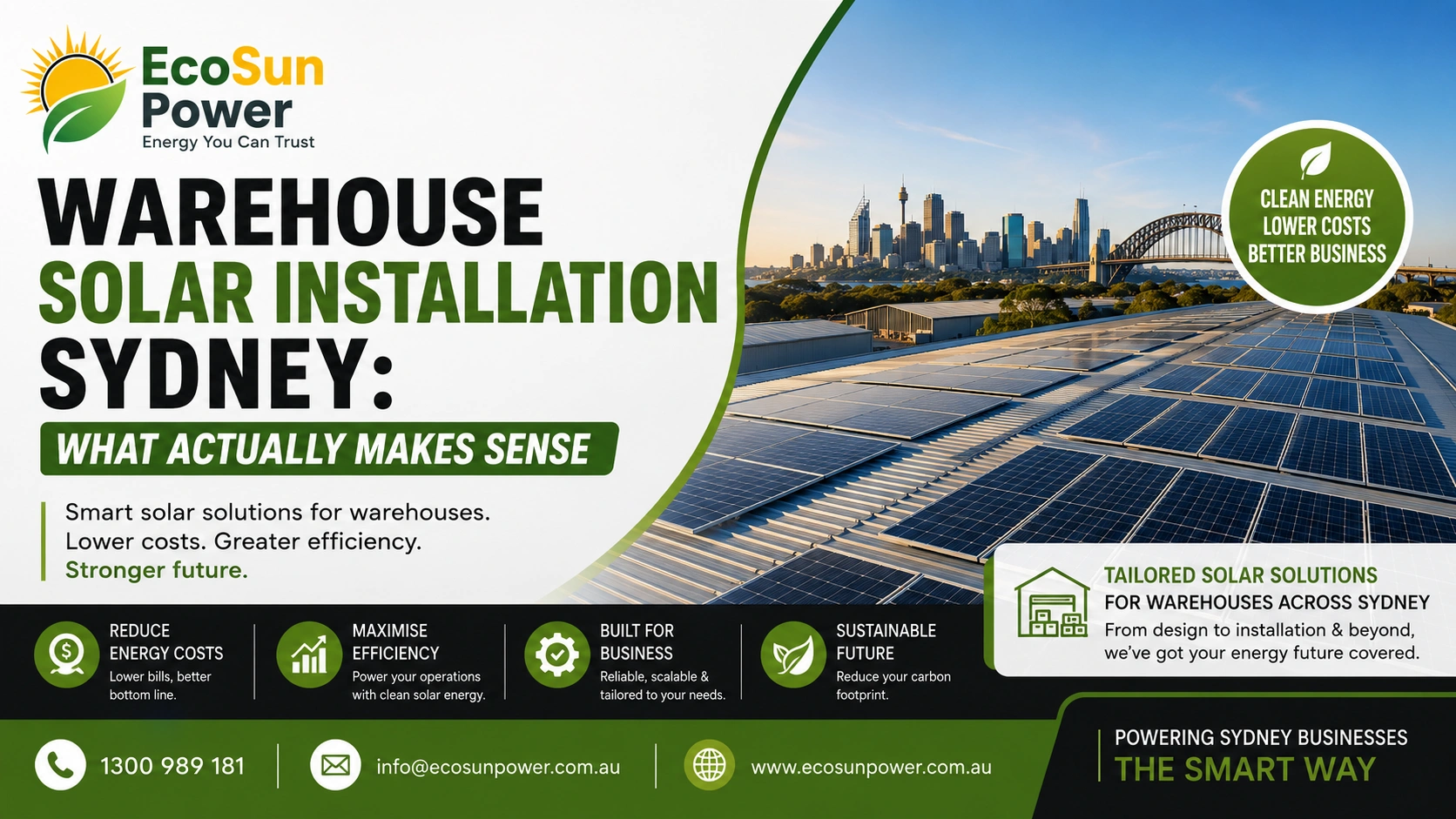
If you run a warehouse in Sydney, electricity probably isn’t the most exciting part of the business.
But the bill gets attention.
Lighting, ventilation, refrigeration, charging equipment, office areas, loading zones, machinery—it all adds up quietly.
That is why warehouse solar installation in Sydney can make practical sense.
Not for every site.
But for warehouses using a decent amount of power during the day, it is definitely worth looking at properly.
The important word there is properly.
Because a big roof does not automatically mean you should cover every possible metre with panels.
Warehouse Roofs Look Perfect for Solar
And often they are.
Large, open roof areas. Usually fewer obstacles than residential properties. Plenty of exposure during the day.
Sounds straightforward.
Then you look closer.
- Skylights
- Ventilation units
- Old roof sections
- Fire access requirements
- Shading from nearby buildings
- Previous roof repairs
That changes things.
Before anyone starts discussing panel numbers, the roof itself needs to be checked.
Pretty basic.
Still gets skipped.
What Should Be Checked on a Warehouse Roof?
Before installation, the roof should be assessed for:
- Structural suitability
- Roof age and condition
- Skylights and roof penetrations
- Ventilation equipment
- Shading
- Safe access
- Fire and maintenance access requirements
- Areas that may require future repairs
A solar system is a long-term investment, so the roof should be ready for it.
Start With the Warehouse Load, Not the Roof Size
This is probably the part that matters most.
How much electricity does the warehouse use during daylight hours?
A distribution warehouse with basic lighting will look very different from a refrigerated warehouse running cooling equipment all day.
Same roof size.
Completely different solar requirement.
Forklift charging can matter too.
So can office air conditioning, conveyors, packing equipment and automated storage systems.
Even shift timing makes a difference.
If most of the warehouse activity happens between morning and late afternoon, solar generation may line up nicely with the actual load.
That is usually where the value sits.
Using the electricity on-site.
Not just generating a big number for the proposal.
What Uses Electricity in a Warehouse?
Depending on the business, electricity consumption can come from:
- Lighting
- Refrigeration and cooling
- Ventilation
- Forklift charging
- Office air conditioning
- Conveyors
- Packing equipment
- Automated storage systems
- Machinery
- Computer and office equipment
Understanding these loads helps determine what size solar system actually makes sense.
Bigger Systems Can Look Impressive
Sometimes too impressive.
Say your roof can physically take a large solar system.
That does not mean the business actually needs all of it.
If your daytime load is much lower than the solar output, a lot of power may end up being exported.
That may still be useful.
But it changes the economics.
A sensible installer should be comfortable recommending a smaller system if the usage data supports it.
That is not underselling.
It is sizing.
There is a difference.
Why System Size Should Match Electricity Usage
The ideal system should consider:
- Daytime electricity consumption
- Operating hours
- Expected solar generation
- Export opportunities
- Future electricity demand
- Available roof area
- Grid connection requirements
Roof capacity is only one part of the decision.
Warehouses Have Very Specific Electricity Habits
This is where generic solar proposals start falling apart.
A warehouse may be almost empty at 7 am, busy by 10 am and much quieter again after 4 pm.
Or it may operate across two shifts.
Or 24 hours.
Friday may be heavy.
Sunday may be dead.
You cannot really understand that from one monthly electricity bill.
Why Interval Usage Data Matters
Interval usage data is much more useful where available.
It shows when the site is actually consuming power.
That makes solar sizing a lot less guessy.
And honestly, for a larger warehouse installation, guessing is not ideal.
Roof Condition Matters More Than People Expect
Panels are meant to stay up there for years.
So if the warehouse roof already needs repairs, deal with that conversation early.
Installing solar first and fixing the roof later is possible.
It is also annoying.
Panels need to come off.
Access needs to be arranged again.
Labour gets paid again.
The warehouse may need another interruption.
Nobody really wins.
Older industrial areas around Sydney can have warehouses with patched roofing, ageing sheets or previous building modifications.
Not necessarily a problem.
Just something worth knowing before installation day.
What Happens If the Roof Needs Repairs?
If repairs are likely, discuss them before finalising the solar installation.
This can help avoid:
- Removing panels later
- Additional labour costs
- Repeated roof access
- Operational disruptions
- Unplanned project delays
Installation Should Not Mess With Warehouse Operations
This sounds obvious until a truck is waiting at the loading dock and the installation team has blocked the access area.
Warehouses run on movement.
People.
Forklifts.
Deliveries.
Dispatch.
Stock coming in and going out.
Solar installation has to work around that.
Roof access, crane work, temporary exclusion zones and electrical shutdowns should be planned with the warehouse schedule in mind.
A short planned shutdown outside peak hours is one thing.
A surprise interruption in the middle of dispatch is another.
Quite a different mood.
Plan Installation Around Warehouse Operations
A commercial solar installation plan should consider:
- Delivery schedules
- Loading dock access
- Forklift movement
- Roof access
- Crane requirements
- Temporary exclusion zones
- Electrical shutdowns
- Peak operating periods
Good planning can reduce unnecessary disruption to the business.
Switchboards Can Become Part of the Job
On commercial and warehouse sites, the panels are only one part of the installation.
The existing electrical setup matters.
Older switchboards may need work.
Protection equipment may need upgrading.
Cable routes can be longer than expected.
Metering arrangements can be more complicated.
This is why a very cheap quote sometimes becomes less cheap once the actual site conditions are checked.
Worth asking exactly what is included.
Not just the panel and inverter price.
What Electrical Work Should You Ask About?
When comparing quotes, ask whether the proposal includes:
- Switchboard upgrades
- Protection equipment
- Cabling
- Metering requirements
- Electrical labour
- Network connection requirements
- Any additional site works
Understanding these costs upfront makes it easier to compare quotes accurately.
Warehouse Solar Monitoring Should Be Boringly Easy
You should be able to check whether the system is working without chasing anyone.
That is the goal.
For a decent-sized warehouse system, monitoring becomes pretty useful.
You want to know if production suddenly drops.
If one inverter stops working.
If the system is producing less than expected.
Not six months later.
Warehouses are busy places. Nobody is standing outside every afternoon wondering whether the rooftop solar looks healthy.
Monitoring should flag the issue.
Simple.
What Should Solar Monitoring Show?
A useful monitoring system can help you track:
- Solar generation
- System performance
- Production changes
- Inverter performance
- Potential faults
- Historical generation data
The easier it is to identify a problem, the easier it is to arrange a response.
Does a Warehouse Need a Battery as Well?
Not always.
This is where the conversation can get expensive quite quickly.
If your warehouse uses most of its electricity during the day, solar may already cover the main use case.
A battery starts becoming more interesting when you have meaningful evening or overnight load.
Or certain demand peaks.
Or a clear backup requirement.
Cold storage sites may look at this differently from a standard storage warehouse.
A warehouse charging electric forklifts overnight may look at it differently again.
So the battery needs a reason to exist.
Not just a line item saying “energy storage solution.”
That phrase alone is not saving anyone money.
When Might a Battery Make Sense?
A battery may be worth considering when the warehouse has:
- Significant evening or overnight electricity usage
- High demand periods
- A backup power requirement
- Specific energy management goals
- Electricity usage that cannot be covered directly by daytime solar
The important thing is to assess the numbers before adding storage.
Refrigerated Warehouses Are a Different Case
Cold storage and food distribution sites can have heavy, consistent electricity demand.
Cooling systems do not care whether the warehouse is busy.
They keep running.
That can make daytime solar consumption fairly strong.
But refrigeration loads also fluctuate.
Outside temperature matters.
Door activity matters.
Stock levels can matter.
So the solar calculation deserves a bit more attention.
Sometimes these sites are genuinely well suited to solar.
Still worth using actual operating data rather than assumptions.
What Can Affect Refrigeration Energy Use?
For refrigerated warehouses, factors can include:
- Outside temperature
- Door opening frequency
- Refrigeration equipment
- Warehouse operating hours
- Stock levels
- Required storage temperature
- Cooling system efficiency
These factors can influence both electricity consumption and solar sizing.
What If the Warehouse Is Leased?
Very common.
A lot of Sydney warehouse operators do not own the building.
That does not automatically kill the solar idea.
But now the landlord enters the conversation.
What Should Tenants Discuss With the Landlord?
Before installing solar, clarify:
- Roof approval
- System ownership
- Lease term
- Maintenance responsibility
- What happens if the tenant moves
- Who receives the financial benefit from the system
- What happens to the solar system at the end of the lease
If you have seven years left on the lease, that is one situation.
If the lease expires next year, very different conversation.
Grid Connection Can Affect Larger Installations
For bigger warehouse systems, the local network may have requirements around connection and export.
Sometimes the site can install more solar than it is allowed to export.
That does not always mean the project becomes unattractive.
It may just mean the system needs export controls or a different design.
Again, this is why the final system size should not be chosen by looking at roof area alone.
The building, electricity use and network all have a say.
Why Export Limits Matter
Before finalising a larger system, it can be useful to understand:
- Available grid connection capacity
- Export limits
- Network requirements
- Possible export control requirements
- How much electricity will be consumed on-site
These factors can affect the final system design and financial calculations.
Compare Solar Quotes Properly
Do not compare only this:
100 kW system versus 100 kW system.
That tells you very little.
Look at the panel models.
Inverters.
Mounting system.
Expected generation.
Included electrical work.
Monitoring.
Warranty support.
Network application.
Access equipment.
Any exclusions.
And most importantly, look at how the installer calculated the savings.
A proposal can make almost any system look good if the assumptions are optimistic enough.
A slightly more conservative forecast is usually easier to trust.
What Should You Compare in a Solar Quote?
When comparing warehouse solar quotes, look at:
- System size
- Panel models
- Inverter models
- Mounting system
- Expected annual generation
- Electrical work
- Monitoring
- Warranty support
- Network application
- Access equipment
- Installation inclusions
- Project exclusions
- Estimated savings
- Assumptions behind the financial forecast
Comparing these details gives you a much clearer picture than comparing the headline price alone.
The Warehouse Itself Should Decide the System
That is really the point.
Not the size of the roof.
Not the number of panels an installer wants to sell.
Not the biggest possible system you can fit.
The warehouse.
When equipment runs.
When staff are on-site.
When forklifts charge.
When refrigeration peaks.
When the building is almost empty.
Those details shape whether warehouse solar installation in Sydney actually works financially.
A good system should quietly reduce the amount of grid electricity the warehouse needs.
Nothing dramatic.
Just lower dependence on purchased power during the hours when the business is already operating.
For a warehouse, that is usually a much better reason to install solar than simply having a big empty roof.






Comments are closed