
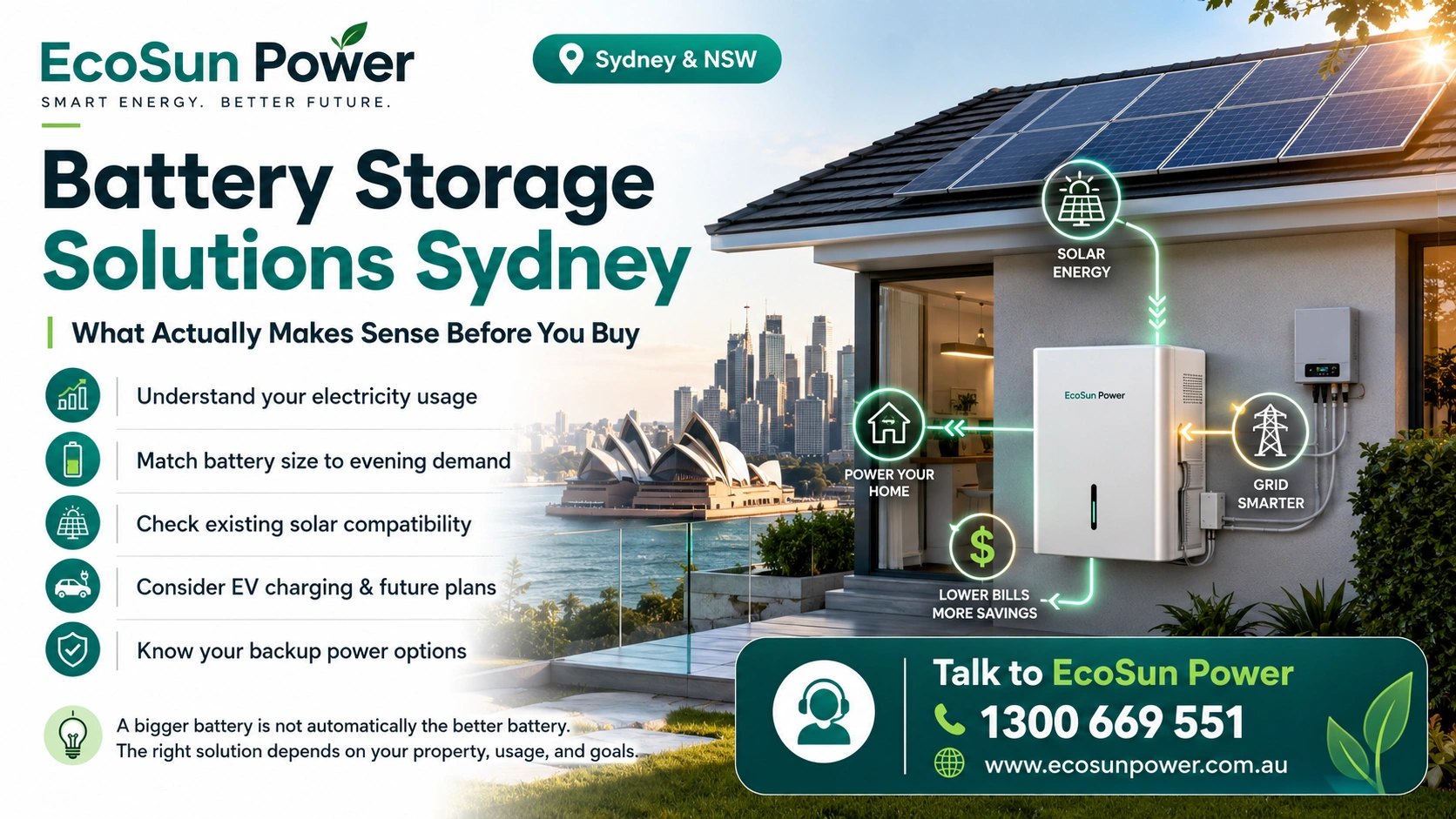
Battery Storage Solutions Sydney: What Actually Makes Sense Before You Buy
Battery storage sounds simple from a distance: your solar panels produce extra power during the day, the battery stores it, and you use that energy later when the sun is no longer shining. In reality, battery storage solutions in Sydney can vary considerably depending on the property, electricity usage patterns and what you actually expect the battery to achieve.
A battery designed mainly to reduce evening grid consumption has a different job from one intended to provide backup power during blackouts. Commercial properties can have completely different requirements again, particularly when peak demand and operating hours are involved. Before choosing a battery, the most important step is therefore understanding the problem you want it to solve.
First Question: Why Do You Want a Battery?
Some Sydney households want to store more of their rooftop solar rather than exporting excess electricity to the grid. Others want to reduce the amount of electricity they purchase in the evening after sending solar power back to the grid during the afternoon. Businesses may be interested in controlling expensive periods of electricity demand, while other properties may prioritise backup power for essential equipment.
These are all valid reasons for installing battery storage, but they do not necessarily lead to the same system design. Buying a battery before deciding exactly what you want it to do can result in paying for capacity or features that may not provide much practical value.
Look at Your Solar Export and Evening Usage
If you already have solar, your export pattern is a useful place to start. A typical household may use relatively little electricity between 9 am and 3 pm while the solar system is producing strongly. If nobody is home and major appliances are not operating, a significant amount of solar energy may be exported.
The situation often changes around 5 or 6 pm when people return home. Cooking begins, lights come on, air conditioning may start running, and televisions, computers, dishwashers and chargers increase electricity consumption. At that point, the solar system may be producing very little, meaning the household starts purchasing electricity from the grid again.
A battery can store some of the unused daytime solar and make it available during these higher-use evening periods.
Don’t Start by Choosing a Battery Size
It is easy to become focused on numbers such as 10 kWh, 13.5 kWh, 20 kWh or even larger systems. However, battery capacity should be the result of analysing your energy requirements rather than the starting point of the decision.
First, consider how much excess solar energy your system normally produces and how much electricity the property consumes after solar production falls. If you regularly have only around 5 kWh of useful excess solar, installing a very large battery could mean that much of its capacity remains unused. On the other hand, a household with high evening consumption may find that a small battery provides only limited coverage.
Usable Capacity and Battery Output Matter
The advertised capacity of a battery does not always represent the amount of energy available for everyday use. Battery specifications may include both total and usable capacity, and some systems may reserve a portion of stored energy for backup. Normal operating limits and system losses should also be considered.
It is equally important to understand the difference between battery capacity and power output. A battery may store a large amount of energy but still have limits on how much power it can deliver at one time. This becomes particularly important when several high-demand appliances operate simultaneously.
Backup Power Requires Separate Planning
A home battery does not automatically mean that the entire house will continue operating normally during a blackout. The system needs to be designed specifically for backup operation, and homeowners should decide which circuits or appliances genuinely need backup.
Keeping a refrigerator, Wi-Fi, essential lights and selected power points operating is very different from trying to run air conditioning, electric ovens, pool equipment, electric hot water and EV charging simultaneously. For many homes, backing up essential circuits can be more practical than attempting to power the entire property.
Sydney Homes Have Different Energy Patterns
A family home in Western Sydney may have a very different electricity profile from an apartment, townhouse or smaller household closer to the CBD. Summer air-conditioning, working from home, electric vehicles, swimming pools, electric hot water and induction cooking can all influence daily consumption.
Electricity usage can also change significantly between seasons. January consumption may look completely different from May, particularly during periods of heavy air-conditioning use. Looking at electricity data across several months can therefore provide a more useful picture than relying on a single bill.
Existing Solar Should Be Checked Before Adding Storage
If solar panels are already installed, adding a battery may not always be a straightforward plug-in process. The existing inverter needs to be checked for compatibility, while switchboard condition, metering, installation space and the age of the solar system may also influence the final design.
Older solar systems may require equipment upgrades before battery storage can be integrated effectively. It makes sense to understand the condition and compatibility of the existing system before making a significant investment in storage.
Commercial Battery Storage Has Different Priorities
For businesses, battery storage can do more than move excess lunchtime solar into the evening. A commercial property may experience short periods of high grid demand when machinery starts, cooling requirements increase, EV charging begins or multiple pieces of equipment operate simultaneously.
A correctly configured battery may be able to discharge during these periods and reduce grid demand. However, timing and control strategy become important. A battery that has already discharged earlier may have limited energy available when a more expensive demand peak occurs.
Battery Savings Are Different for Every Property
Battery savings should not be treated as a fixed feature of the equipment. A battery installed at a property with plenty of excess solar and high evening consumption may be used extensively, while the same battery installed at a low-consumption property could remain partially charged for long periods.
Electricity tariffs, solar generation, battery efficiency, system programming and household habits all influence the final result. Even relatively small behavioural changes, such as when certain appliances are used, can affect how efficiently stored energy is utilised.
Improve Obvious Energy Inefficiencies First
Installing a battery does not eliminate inefficient electricity use. An old air conditioner still consumes significant power, poor insulation continues to affect heating and cooling requirements, and equipment left running unnecessarily still uses energy.
Addressing obvious energy inefficiencies before selecting battery capacity can sometimes reduce the amount of storage required.
Installation Location, Monitoring and Warranty
Battery location also deserves careful consideration. Installation requirements, equipment clearances, accessibility and future servicing should all influence where the system is positioned.
Monitoring is equally valuable. A useful monitoring platform should make it easy to understand solar production, property consumption, battery charge and discharge activity, and electricity imported from the grid. Over time, this information can reveal whether the battery is filling too early, emptying too quickly or rarely reaching full charge.
Warranty conditions should also be examined beyond the headline number of years. Capacity retention, throughput conditions, usage limits and the process for obtaining warranty support can all matter over the life of the system.
Compare the Entire Battery Quote
A cheaper battery quote is not automatically a bad quote, but it should be compared carefully with other offers. Check whether the price includes the battery, inverter or hybrid inverter, backup equipment, metering, switchboard work, monitoring, installation and any required electrical upgrades.
One quotation may appear cheaper simply because certain work has not been included. Comparing the complete scope provides a much clearer picture than comparing only battery brands and final prices.
Choose Storage That Solves a Real Problem
Good battery storage solutions in Sydney should address something you can clearly identify, whether that is excess solar export, heavy evening electricity consumption, demand peaks, backup requirements or expensive time-of-use periods.
The goal is not necessarily to install the largest battery your property can accommodate. It is to choose enough storage to match the way the property actually produces and consumes electricity. For some properties, that may mean a modest battery; for others, a larger system makes sense. In some cases, installing solar first and collecting real usage data before adding a battery may be the smarter decision.
The right battery is ultimately the one that has a clear job, is properly sized for that job and works effectively with the rest of your energy system.






Comments are closed